
Carousel Digital Signage Achieves Substantial Conformance with WCAG 2.1 Level AA Requirement
We've been working on making Carousel meet and exceed accessibility well before the mandate, not because we had to, but
Press Release Disclaimer: This is a press release distributed through the XPR Media network. It has not been independently verified by our newsroom.
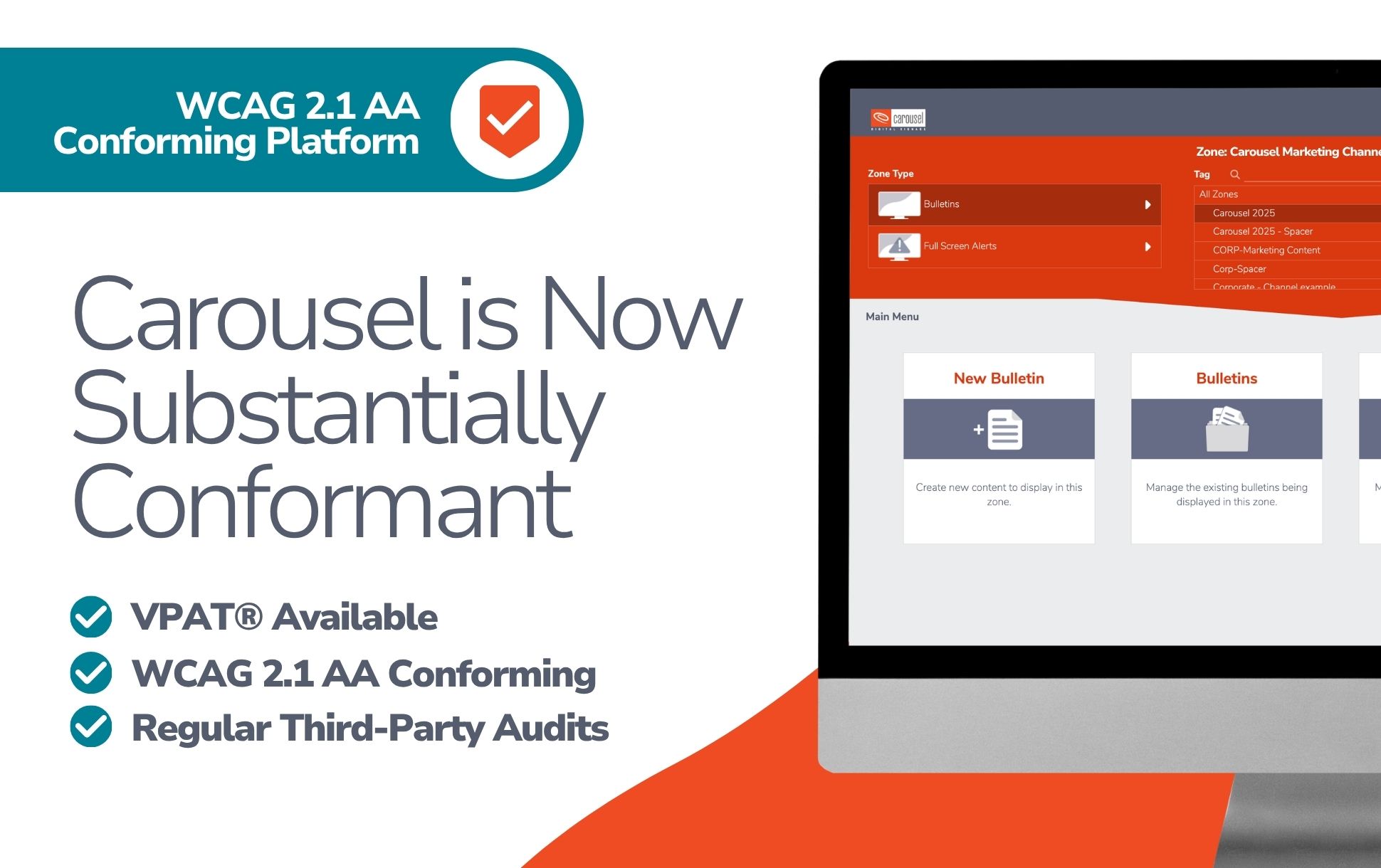

MINNEAPOLIS, MN, UNITED STATES, October 20, 2026 /EINPresswire.com/ — Today, Carousel announced that its web-based digital signage content management system (CMS) substantially conforms to the Web Content Accessibility Guidelines (WCAG) 2.1 Level AA and 2.2 Level AA. WCAG 2.1 Level AA is the technical standard created by the World Wide Web Consortium (W3C), and it is now mandated under Title II of the Americans with Disabilities Act (ADA) for state and local government entities. For organizations that rely on Carousel, including municipalities and public colleges and universities facing new federal requirements, the result is a digital signage platform that people with disabilities can operate more easily.
In 2024, the U.S. Department of Justice (DOJ) issued a final rule under Title II of the ADA that requires state and local governments, including public schools, colleges, and universities, to make their web content and mobile applications meet WCAG 2.1 Level AA. Following a one-year extension issued in April 2026, public entities serving populations of 50,000 or more must comply by April 26, 2027, and smaller entities and special district governments by April 26, 2028. The obligation extends to third-party software these organizations use to deliver services.
Key areas of compliance include:
•Text alternatives for images and other non-text content
•Sufficient color contrast for text and interface elements
•Full keyboard operability with a visible focus indicator
•Compatibility with screen readers and other assistive technologies
•Descriptive headings, labels, and page structure
•Accessible forms with descriptive labels and error messages
•Text that resizes and reflows without loss of content
•Controls to pause, stop, or hide moving, blinking, scrolling, or auto-updating content
Carousel partnered with the digital accessibility firm Level Access to identify accessibility issues in its web-based software through automated and manual testing. Carousel then remediated any issues found and had Level Access retest them until the criteria were met. Because WCAG 2.2 builds on 2.1 and includes all of its Level AA criteria, the audit confirms that Carousel meets the federal requirement and addresses newer criteria such as larger target sizes (the size of an interactive element like a button), ensuring that focus isn’t obstructed by other content, and providing alternatives to dragging (e.g., re-ordering active content without dragging). Level Access’s findings are documented in a conformance report in the Voluntary Product Accessibility Template (VPAT®) format. For more information, visit Carousel’s accessibility webpage.
Carousel has long prioritized accessibility. For years, its software has included the Carousel Accessibility (A11Y) Site that presents an organization’s digital signage content that can be read by screen readers. “We’ve been working on making Carousel meet and exceed accessibility well before the mandate, not because we had to, but because we think it’s the right thing to do,” said JJ Parker, co-founder of Carousel Digital Signage. With this milestone, people who use screen readers and keyboard navigation can now manage their organization’s digital signage as easily as everyone else. By conducting annual audits with Level Access, Carousel continues to incorporate accessibility standards into its development process and provide a feedback channel for users to report accessibility obstacles.
Marketing
Carousel Digital Signage
+1 612-261-1000
Legal Disclaimer:
EIN Presswire provides this news content “as is” without warranty of any kind. We do not accept any responsibility or liability
for the accuracy, content, images, videos, licenses, completeness, legality, or reliability of the information contained in this
article. If you have any complaints or copyright issues related to this article, kindly contact the author above.

Media gallery

