Key Factors Buyers Consider When Selecting a Peptide API Manufacturer
Just another WordPress site
Press Release Disclaimer: This is a press release distributed through the XPR Media network. It has not been independently verified by our newsroom.

Hangzhou, Zhejiang, China – October 20, 2026
As peptide-based therapies continue to develop, pharmaceutical companies are facing a practical challenge: finding a reliable partner that can supporT Peptide development and manufacturing from an early-stage project to commercial production.
For buyers, choosing a Peptide API Manufactureris therefore about more than comparing quotations. Peptide structure, synthesis process, purification, analytical testing, production scale, Quality Management, and technical communication can all affect the progress of a project.
A supplier that can provide only a finished peptide may not be enough for companies looking for long-term development and manufacturing support.
1. Start With the Manufacturer’s Technical Capabilities
Peptide manufacturing involves multiple technical steps, and different peptide molecules can present different production challenges.
Sequence complexity, molecular size, purity requirements, synthesis yield, purification difficulty, and stability can all influence the development process.
For this reason, buyers should first understand what technical capabilities a manufacturer actually provides.
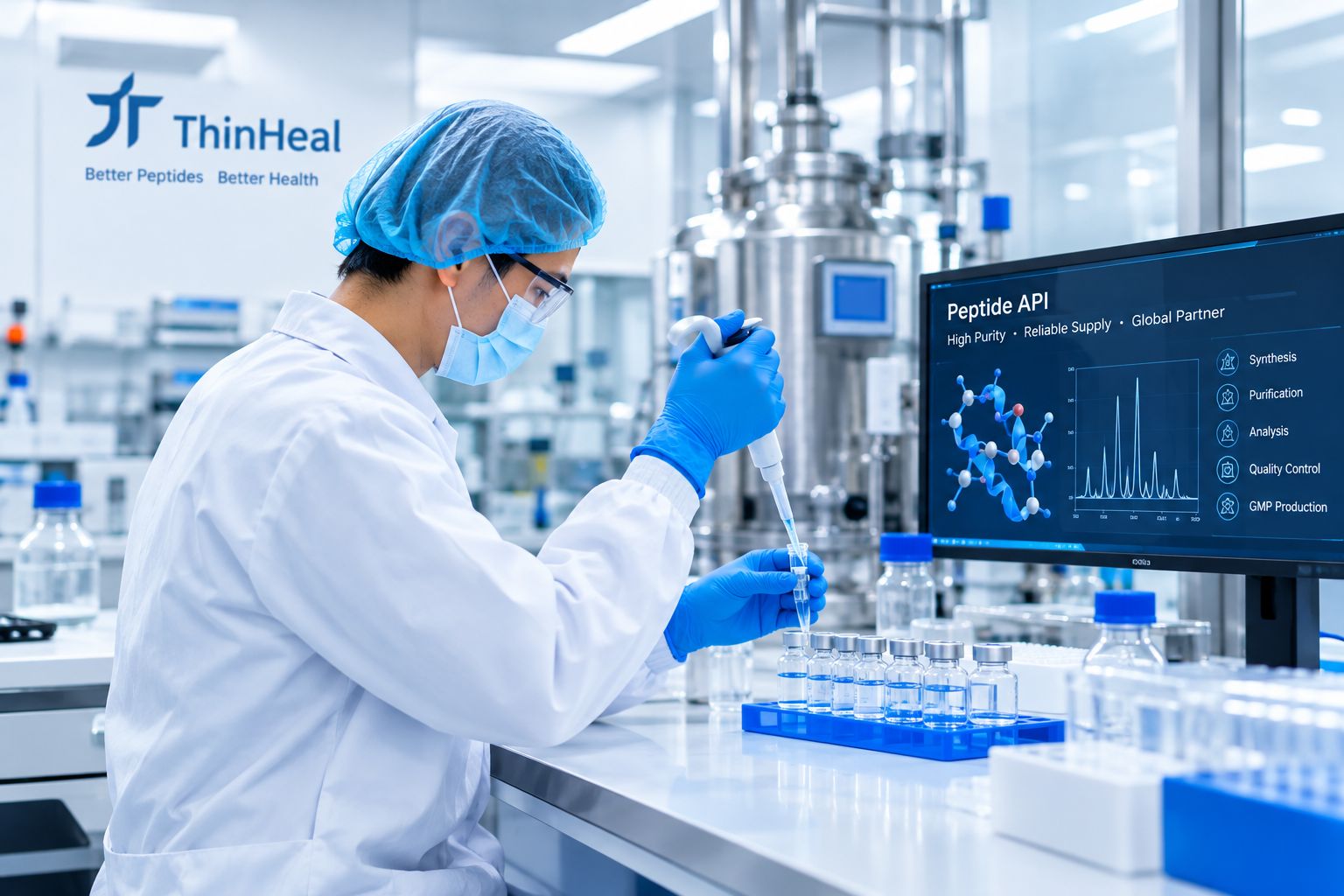
Thinheal Pharma-Tech focuses on peptide R&D, production, sales, and customized research and development and manufacturing. The company states that its management team has nearly 20 years of experience in the peptide industry and that its chemically synthesized peptide production capacity has reached several tons.
For pharmaceutical companies, this type of technical background can be relevant when evaluating whether a supplier can support projects beyond simple product sourcing.
2. Development Capability Matters Before Commercial Production
A peptide project does not normally begin with large-scale manufacturing.
Before production can be scaled, manufacturers may need to evaluate synthesis routes, purification methods, analytical procedures, process parameters, and other technical factors.
This makes Peptide Development Services an important consideration for companies working on new peptide products.
A manufacturer involved in development can identify potential process problems earlier and optimize the production route before moving toward larger batches.
This approach can also help companies avoid repeatedly changing suppliers as a project moves from development to manufacturing.
3. Consider Custom Manufacturing Requirements
Not every pharmaceutical company needs an off-the-shelf peptide.
Some projects require a specific peptide sequence, purity target, batch size, production process, or other technical specification. In these cases, Custom Peptide Manufacturing can provide greater flexibility.
The buyer should communicate the project requirements as clearly as possible, including the peptide sequence, expected quantity, intended application, quality requirements, and development stage.
A capable manufacturer can then evaluate the technical requirements and determine an appropriate development and production approach.
Thinheal’s service portfolio includes custom peptide development and CRO services as well as CDMO solutions, allowing customized projects to be integrated with its broader peptide manufacturing capabilities.
4. Quality Control Should Be Evaluated at Every Stage
Peptide quality is not determined only by the final purity result.
Raw materials, synthesis, purification, drying, packaging, storage, and analytical testing can all influence the final product.
For pharmaceutical applications, buyers should therefore look at the manufacturer’s quality system and production controls rather than focusing on a single certificate or test result.
Documentation is also important. Depending on the project, customers may require analytical data, batch information, specifications, stability-related information, or regulatory documentation.
Thinheal states that its quality and development system supports peptide API R&D and production, while its company milestones include ISO 9001 certification and GMP facility expansion. The company also reports having filed three DMFs with the U.S. FDA in 2024.
These capabilities can be relevant for pharmaceutical companies evaluating suppliers for regulated development and manufacturing projects.
5. Production Scale Should Match the Project Stage
The manufacturing requirements for an early development project can be very different from those of a commercial API.
A supplier may need to support different quantities as the project progresses from laboratory development to process validation and larger-scale manufacturing.
This is one reason why production capacity should be evaluated together with process flexibility.
A manufacturer with both development and production capabilities may be able to support a project through multiple stages instead of requiring the customer to transfer the process to another supplier later.
For buyers, this can simplify supplier management and reduce unnecessary technology-transfer work.
6. CDMO Services Can Simplify the Supply Chain
For companies that do not want to manage every part of peptide development internally, Peptide CDMO Services can provide a more integrated approach.
A CDMO partner may support activities such as process development, analytical work, scale-up, manufacturing, and other project-related services depending on the scope of cooperation.
Thinheal describes its CDMO business as including project-based entrusted R&D, entrusted production, and sales. Its overall service structure also covers API R&D and production, customized R&D and manufacturing, and beauty peptide development and production.
For pharmaceutical companies, the value of this model is not simply having another supplier. It is having a partner that can coordinate multiple stages of the development and manufacturing process.
7. Regulatory Experience Can Be Important
Peptide API manufacturing for pharmaceutical applications often involves more documentation and quality requirements than general research-use products.
Therefore, buyers should consider whether a potential supplier understands the documentation and quality expectations associated with pharmaceutical manufacturing.
Thinheal’s current company information lists GMP facility development, ISO 9001 certification, DMF filings, and preparation for global markets among its development milestones.
However, buyers should still confirm the exact regulatory status, documentation, and applicable certifications for the specific peptide and market involved rather than assuming that one qualification applies to every product.
8. Communication Is Part of Manufacturing Capability
Technical communication is often underestimated when selecting a peptide supplier.
A project may involve discussions about Peptide Sequences, specifications, analytical methods, batch sizes, delivery schedules, packaging, and documentation. If technical information is not communicated clearly, even a technically capable supplier can become difficult to work with.
For international pharmaceutical companies, an experienced project team that can communicate clearly across different stages of development can make cooperation more efficient.
A good supplier should be able to explain what can be achieved, what information is required, and which technical points still need confirmation before production.
A Practical Checklist for Choosing a Peptide Manufacturer
Before selecting a supplier, pharmaceutical and biotechnology companies can compare the following points:
- Peptide Synthesis capabilities
- Purification and analytical capabilities
- Development and scale-up experience
- Custom manufacturing support
- Quality management system
- Production facilities
- Regulatory documentation
- Available production capacity
- Project communication
- Long-term CDMO support
This checklist provides a more complete picture than comparing the initial quotation alone.
Why an Integrated Peptide Manufacturing Partner Matters
Peptide projects can become increasingly complex as they move from research to development and commercial manufacturing.
For this reason, an integrated Pharmaceutical Peptide Manufacturing partner can provide value by connecting R&D, process development, quality control, production, and project management.
Thinheal’s current service structure covers peptide APIs, custom R&D and manufacturing, CDMO solutions, and cosmetic peptides. Its product portfolio includes therapeutic peptide categories such as GLP-1 analogues, GLP-2 analogues, gastrointestinal peptides, and other therapeutic peptide APIs.
This integrated structure gives buyers a broader range of options when planning peptide development and manufacturing projects.
Conclusion
Choosing a Peptide API Manufacturer should be based on more than price, product availability, or a single quality certificate.
Technical capabilities, development experience, custom manufacturing, analytical control, production scale, regulatory support, and communication all deserve consideration.
For companies developing peptide-based pharmaceutical products, an integrated manufacturing partner can also reduce the need to change suppliers as the project progresses.
By evaluating the complete manufacturing capability before starting cooperation, buyers can establish a clearer development pathway and select a supplier that is better aligned with their long-term project requirements.
About Us
Hangzhou Thinheal Pharma-Tech Co., Ltd. was established in 2019. It is a biopharmaceutical company that combines independent R&D, production, sales and customized research and development and production of peptide products.
Media Contact
Company Name: Hangzhou ThinHeal Pharma-Tech Co., Ltd
Contact Person: Media Relations
Email: Send Email
Country: China
Website: https://www.thinhealpeptide.com/
Press Release Distributed by ABNewswire.com
To view the original version on ABNewswire visit: Key Factors Buyers Consider When Selecting a Peptide API Manufacturer