
Cinnamon Market Poised to Reach USD 2.29 Billion by 2035 as Premium and Traceable Supply Gains Momentum
Rising food and beverage use, nutraceutical applications, origin certification and supply-chain traceability are
Press Release Disclaimer: This is a press release distributed through the XPR Media network. It has not been independently verified by our newsroom.
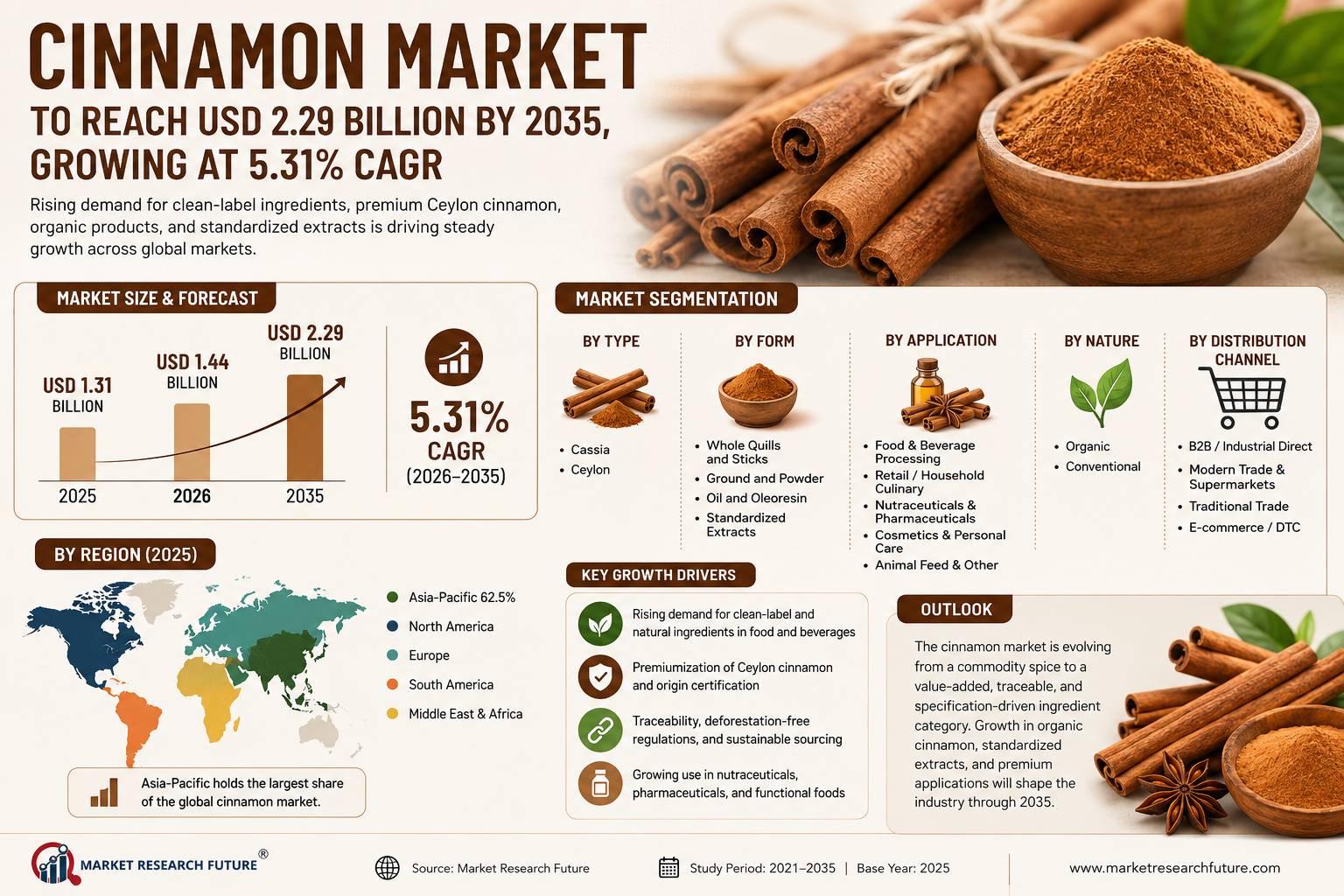

Rising food and beverage use, nutraceutical applications, origin certification and supply-chain traceability are reshaping global cinnamon demand through 2035.
NEW YORK, NY, UNITED STATES, August 25, 2026 /EINPresswire.com/ — The global Cinnamon Market is entering a sustained period of expansion, with market value projected to increase from USD 1.31 billion in 2025 to USD 1.44 billion in 2026 and USD 2.29 billion by 2035, registering a 5.31% compound annual growth rate (CAGR) during the forecast period from 2026 to 2035.
The growth trajectory reflects a gradual transformation in how cinnamon is sourced, processed, specified and marketed across food and beverage, retail culinary, nutraceutical, pharmaceutical, cosmetics and personal care applications. While cinnamon remains a globally familiar culinary spice, the market is increasingly being shaped by premium origin positioning, clean-label formulation, traceability requirements, organic certification, value-added processing and demand for standardized botanical extracts.
According to Market Research Future’s analysis, the cinnamon industry is moving beyond a predominantly volume-driven commodity structure toward a more differentiated market in which origin, grade, composition, documentation and processing capability increasingly influence commercial value. The report covers cinnamon by type, form, application, nature, distribution channel and geography, providing a detailed view of the forces expected to shape the market through 2035.
Cinnamon Market Enters a New Phase of Value-Driven Growth
Cinnamon has traditionally been traded largely on volume, price and flavour intensity. However, evolving buyer requirements are creating a more segmented marketplace.
Industrial food manufacturers continue to depend heavily on cost-effective cassia varieties for bakery, confectionery and flavour applications, while premium retail, nutraceutical and specialty food manufacturers are placing greater emphasis on Ceylon cinnamon, certified organic products, standardized extracts and documented origin.
This differentiation is becoming particularly important as food manufacturers, retailers and ingredient buyers seek greater transparency in agricultural supply chains. Traceability is increasingly moving from a compliance exercise to a commercial differentiator, allowing suppliers with farm-level records, certification and consistent grading to access higher-value contracts.
The shift is also creating opportunities for processors capable of converting raw cinnamon bark into higher-value formats such as oils, oleoresins and standardized extracts.
Get Full PDF Sample Copy of Report: (Including Full TOC, List of Tables & Figures, Chart) @ https://www.marketresearchfuture.com/sample_request/41511
Cassia Continues to Lead the Market by Type
Cassia remains the dominant cinnamon type, accounting for approximately 71.4% of the market by type in 2025, supported by its broad use in industrial bakery, food processing and flavour applications. Ceylon cinnamon, also known as true cinnamon, represents a smaller share but occupies an important premium position because of its differentiated origin, sensory profile and lower-coumarin characteristics.
The commercial distinction between the two categories is becoming increasingly relevant in international markets.
Cassia varieties continue to benefit from their suitability for high-volume industrial applications, where manufacturers prioritize flavour intensity and competitive input costs. Ceylon cinnamon, by contrast, is gaining attention in premium culinary products, specialty retail, origin-branded offerings and applications where buyers place greater emphasis on product differentiation and composition.
This two-tier market structure is expected to persist through 2035, with cassia maintaining its volume leadership while Ceylon cinnamon captures premium opportunities where provenance and specification justify higher prices.
Clean-Label Food Formulations Strengthen Demand
Food and beverage processing remains the largest application segment, accounting for approximately 54.2% of global cinnamon consumption in 2025. Cinnamon’s established role in bakery, confectionery, cereals, beverages and dairy-alternative products gives the market a substantial underlying demand base.
At the same time, clean-label reformulation is creating additional opportunities for cinnamon-derived ingredients.
Food manufacturers are increasingly examining natural flavouring and botanical ingredients as consumers pay greater attention to ingredient lists and product positioning. Cinnamon can provide both recognizable flavour and botanical positioning, making it relevant to products marketed around natural ingredients and simplified formulations.
Whole sticks and quills remain important in retail culinary and foodservice applications, while ground cinnamon serves high-volume manufacturing requirements. Oils and oleoresins provide more concentrated flavour and functional properties for ingredient formulators, while standardized extracts are opening a separate value-added opportunity in nutraceutical and pharmaceutical formulations.
The resulting market structure means that growth is not limited to additional cinnamon consumption. It is also being generated by greater processing intensity and movement into higher-value ingredient formats.
Nutraceuticals and Standardized Extracts Create New Growth Opportunities
Although food and beverage processing remains the largest application, nutraceutical and pharmaceutical applications are among the fastest-growing areas, expanding at an estimated 7.1% CAGR through 2035. Standardized extracts are likewise identified among the fastest-growing product forms.
This development reflects growing interest in botanical ingredients for functional nutrition and wellness products.
Cinnamon extracts can be standardized according to defined specifications, allowing manufacturers to develop more consistent ingredient systems than would be possible using undifferentiated bulk spice. This creates opportunities for ingredient suppliers with extraction, quality-control and testing capabilities.
However, the growing health-oriented application of cinnamon also places greater importance on scientific substantiation and regulatory discipline. Market participants increasingly need to distinguish between legitimate ingredient functionality and unsupported health claims.
The opportunity therefore extends beyond simply selling cinnamon as a botanical. It involves developing consistent, documented and specification-driven ingredients that can satisfy the procurement and quality requirements of supplement, pharmaceutical and functional-food manufacturers.
Organic Cinnamon Gains Strategic Importance
Organic cinnamon is projected to grow faster than conventional cinnamon, with the organic segment estimated to register a 7.4% CAGR from 2026 to 2035, compared with approximately 4.9% for conventional products.
The growth of organic cinnamon reflects expanding demand for certified ingredients across premium retail, natural food, specialty grocery and clean-label product categories.
Certification is also increasingly intertwined with supply-chain documentation. Buyers are looking not only for an organic claim but for evidence that the relevant lot is covered by the appropriate certification and transaction documentation.
For producers and exporters, this creates both an opportunity and a cost. Certification, traceability, testing and documentation require investment, but suppliers that successfully integrate these capabilities can differentiate themselves from lower-cost commodity competitors.
As premium grocery and private-label brands expand their use of origin-specific and certified ingredients, organic cinnamon is positioned to capture a growing share of the value generated by the category.
Traceability Reshapes the Cinnamon Supply Chain
One of the most significant structural developments in the cinnamon industry is the increasing importance of supply-chain traceability.
European regulatory requirements concerning deforestation-free supply chains have encouraged importers and suppliers to improve farm-level documentation and geolocation records. The MRFR analysis notes that these requirements have encouraged operators to map smallholder plots and strengthen due-diligence systems.
For the cinnamon industry, this is particularly important because production is highly fragmented among smallholders across major producing regions.
Traceability therefore has the potential to become a commercial asset rather than simply an administrative burden. Exporters and cooperatives that can provide reliable farm-level records, certification information, lot identification and quality documentation may be better positioned to negotiate long-term relationships with international buyers.
The market is consequently moving toward a model in which documented provenance can support premium pricing and longer-term supply agreements.
Regional Outlook
Asia-Pacific Maintains Market Leadership
Asia-Pacific is expected to remain the dominant regional market, accounting for approximately 62.5% of global cinnamon market share in 2025. The region’s importance comes from its combination of major production origins, processing capabilities and large domestic consumption markets.
China, India, Indonesia, Vietnam and Sri Lanka each play distinct roles across the regional value chain.
Indonesia and Vietnam remain important origins for cassia and other cinnamon products, while Sri Lanka maintains a distinctive position in Ceylon cinnamon. India contributes both consumption and processing capacity, including the production of oleoresins and other value-added botanical ingredients.
The Asia-Pacific market is also increasingly characterized by investment in processing, grading, export consolidation and supply-chain documentation. These developments could allow producing countries to retain a greater portion of the value historically captured further downstream.
North America and Europe Favor Premium and Functional Applications
North America represents a mature but attractive market, supported by food manufacturing, specialty retail, dietary supplements, functional beverages and e-commerce.
The region’s demand is increasingly divided between traditional culinary consumption and value-added cinnamon ingredients. Supplement manufacturers and functional beverage companies are contributing to demand for extracts and other concentrated formats, while clean-label food formulation continues to support conventional cinnamon consumption.
Europe presents a different opportunity profile. Regulatory compliance, origin documentation, organic certification and compositional specifications are particularly important considerations for suppliers serving European customers.
The market’s regulatory environment can increase the cost of market entry, but it can also reward suppliers that provide consistent quality and transparent sourcing.
Middle East & Africa Emerges as a High-Growth Region
The Middle East and Africa region is projected to record the fastest regional CAGR of approximately 6.3% from 2026 to 2035.
Growth is supported by expanding foodservice activity, beverage consumption, premium retail and the development of new agricultural supply sources.
The region also presents an emerging opportunity for supply diversification. Countries such as Madagascar and Tanzania have potential to develop certified organic spice production, creating additional origins for international buyers seeking to diversify sourcing.
At the same time, Gulf markets provide important consumption and re-export infrastructure, enabling traders to consolidate and distribute products across regional markets.
Distribution Channels Continue to Evolve
B2B and direct industrial procurement remains the leading distribution channel, accounting for approximately 61.8% of the market in 2025. This reflects the large volumes purchased by food manufacturers, flavour houses, ingredient processors and other industrial customers.
Modern trade and supermarkets represent an important channel for branded and private-label cinnamon, particularly premium and origin-specific products.
E-commerce and direct-to-consumer channels remain smaller but strategically significant. Origin-branded cinnamon products can use digital platforms to reach consumers directly, reducing reliance on multiple intermediary layers and allowing producers to communicate provenance, certification and product differentiation.
This channel shift is particularly relevant for small, premium lots that may not compete effectively in commodity bulk markets.
Competitive Landscape Remains Fragmented
The global cinnamon industry remains relatively fragmented at the production level, with numerous smallholder farmers supplying exporters, processors and branded companies.
At the processing and distribution stages, however, larger organizations are increasingly investing in sourcing networks, sterilization, extraction, quality assurance, certification and traceability.
Companies identified in the market analysis include McCormick & Company, Olam Food Ingredients, Synthite Industries, Mane Kancor Ingredients, Döhler Group, Givaudan/Naturex, Silvermill Group, PT Cassia Coop, Vinasamex, Frontier Co-op and EOAS Organic. Their positioning spans branded retail, bulk sourcing, botanical extraction, essential oils, organic products and origin-focused cinnamon supply.
Competition is therefore expected to increasingly center on capabilities rather than raw product availability.
Suppliers able to combine reliable sourcing with testing, certification, traceability, processing and customer-specific specifications are likely to be better positioned as buyers become more selective.
Key Market Challenges
Despite the positive outlook, the cinnamon industry faces several structural challenges.
Coumarin-related regulatory considerations can affect cassia-based formulations, particularly in markets with defined limits for certain food applications. Climate variability can also affect harvest volumes and pricing, while the concentration of production in a relatively small number of major origins increases exposure to weather-related supply disruptions.
Labour availability represents another concern, particularly for Ceylon cinnamon, where skilled peeling remains an important part of production. Rising labour costs and an ageing skilled workforce can place pressure on supply and pricing.
Adulteration and quality assurance also remain concerns in ground spice markets. As buyers demand greater consistency, suppliers are expected to invest more heavily in testing, sterilization, lot control and documentation.
Future Outlook
Looking toward 2035, the cinnamon industry is expected to become increasingly differentiated.
The traditional bulk-spice business will continue to represent the largest portion of overall demand, but a growing proportion of value is likely to come from premium origin products, organic certification, traceable supply chains, standardized extracts, oils, oleoresins and specialized formulations.
Technology is expected to support this transition through farm mapping, digital traceability, machine-assisted grading and improved processing systems. At the same time, continued development of botanical extraction technologies could enable processors to capture greater value from both bark and secondary plant materials.
The market is also likely to see greater integration between cinnamon sourcing and sustainability requirements. Buyers are increasingly evaluating not just whether a supplier can deliver the required quantity, but whether that supplier can demonstrate where the product came from and how it was produced.
For companies operating across the cinnamon value chain, this creates a clear strategic message: scale remains important, but documented quality, origin, compliance and value-added processing are becoming equally important sources of competitive advantage.
With the global Cinnamon Market forecast to rise from USD 1.31 billion in 2025 to USD 2.29 billion by 2035 at a 5.31% CAGR, the coming decade is expected to create opportunities across cultivation, processing, extraction, certification, distribution and premium consumer products.
The companies best positioned to benefit will be those capable of connecting agricultural supply with increasingly sophisticated buyer requirements — transforming cinnamon from a largely undifferentiated commodity into a traceable, specification-driven and increasingly value-added global ingredient.
Discover Related Research Reports By Market Research Future:
Spices Seasonings Market
https://www.marketresearchfuture.com/reports/spices-seasonings-market-6606
Organic Spices Market
https://www.marketresearchfuture.com/reports/organic-spices-market-1852
Organic Spices Market
https://www.marketresearchfuture.com/reports/organic-spices-market-1852
Market Research Future
Market Research Future
+1 855-661-4441
email us here
Legal Disclaimer:
EIN Presswire provides this news content “as is” without warranty of any kind. We do not accept any responsibility or liability
for the accuracy, content, images, videos, licenses, completeness, legality, or reliability of the information contained in this
article. If you have any complaints or copyright issues related to this article, kindly contact the author above.

Media gallery

